

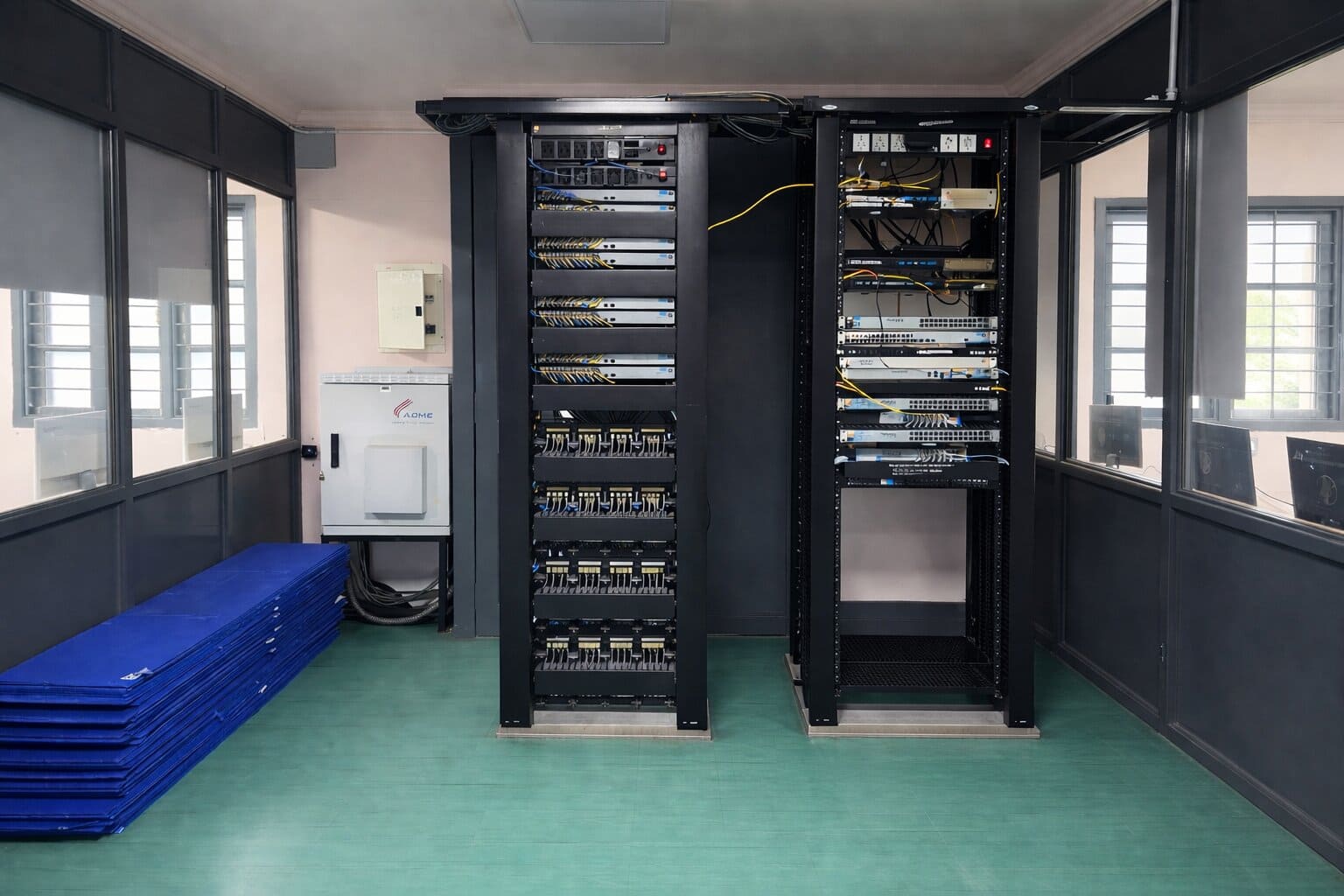
“Our state-of-the-art computer labs provide high-performance systems and cutting-edge software for hands-on learning."
This program equips students with the knowledge and skills required to pursue careers as Software Developers, Hardware Engineers, System Designers, System Analysts, Architects, Network Engineers and Administrators, Database Administrators, Web Developers, and Project Leaders.It enables students to develop a comprehensive and multidimensional understanding of computing concepts, fostering analytical thinking, creativity, and problem-solving abilities. The curriculum encourages students to approach complex challenges with innovation, logical reasoning, and sensitivity to diverse technological and societal needs.The program includes courses such as Computer Graphics, Artificial Intelligence, Human-Computer Interaction, Robotics, Database Management Systems, Web Technologies, Network Security, Grid and Cloud Computing, and Cyber Security. These subjects help students analyze, design, and implement solutions for real-time complex problems. Applications include developing educational software and computer models, creating 3D visualizations of historical artifacts, natural language processing, medical image analysis, computer-generated art, and designing advanced algorithms to support modern network technologies.
●Cyber Security Engineers can take up diverse roles across various industries. They may be involved in
designing and developing software applications tailored to different industrial needs.
● Their responsibilities can also include managing and maintaining software systems, hardware
infrastructure, and network security within organizations. In some roles, they contribute to the design and
development of hardware components for personal computers and laptops.
● They may also develop software for peripheral devices such as printers, modems, and scanners.
Additionally, they write and optimize code and algorithms for operating systems like Windows and Linux.
Cyber Security Engineers also play a key role in developing processes and software solutions for both
domestic and industrial automation systems.
To commit to build a secured cyber cosmos to scaffold the global technological advancements.
AALIM MUHAMMED SALEGH College Of Engineering, Muthapudupet, Avadi, IAF, Chennai - 600 055.
Engineering Graduates will be able to:
The Students will be able to
● Exhibit design and programming skills to build and automate business solutions using cutting
edge technologies.
● Strong theoretical foundation leading to excellence and excitement towards research, to
provide elegant solutions to complex problems
Graduates can
●Apply their technical competence in computer science to solve real world problems, with
technical and people leadership.
● Conduct cutting edge research and develop solutions on problems of social relevance.
● Work in a business environment, exhibiting team skills, work ethics, adaptability and lifelong
learning.
Foundations:
- Learn basics: Networking, OS, Programming (Python, C)
- Get certifications: CompTIA A+, Network+
Core Skills:
- Dive into: Threat analysis, Cryptography, Security frameworks
- Certs: CompTIA Security+, CISSP (if advanced)
Specialize:
- Choose paths: Pen testing, Incident response, Cloud security...
- Tools: Learn Nmap, Metasploit, AWS/Azure security
Practice:
- CTFs, bug bounty, internships
- Join communities: OWASP, HackerOne
To Implement state-of-the-art technologies in the curriculum.
To become an academic excellence in the new generation education and motivate continual learnings
To strengthen self-blended, Experience based learning methodologies
To Promote research activities
To become a nationally recognized Centre of Excellence in Computer Science and Engineering.
To Develop strong industry–institute collaborations for research, internships, projects and technology transfer.
Establish centers to support entrepreneurial and start-ups
The primary goals of cybersecurity Engineers are to protect data and assets by ensuring the confidentiality, integrity, and availability of sensitive information and critical systems. Organizations must also work to prevent cyberattacks by detecting and responding to threats in real time in order to minimize the likelihood and impact of security breaches. Ensuring compliance with regulatory requirements, industry standards, and internal security policies is another essential objective, helping maintain trust and avoid legal or financial penalties. In addition, educating and training employees is crucial for building strong security awareness and reducing risks caused by human error. Improving incident response capabilities through the development and refinement of response plans enables faster detection, containment, and recovery from security incidents. Finally, staying ahead of evolving threats requires continuous monitoring of the cybersecurity landscape and regular updates to security measures to maintain a strong and resilient security posture.
Phase 1(sem 3): Build Tech Foundations
- Learn networking basics (IP, ports, protocols)
- Understand OS fundamentals (Windows/Linux)
- Get comfortable with Linux commands and Python scripting
Phase 2(sem 4): Core Security Concepts
- Study cyber threats, firewalls, IDS/IPS, SIEM
- Learn risk management and vulnerability assessment
Phase 3(sem 5): Hands-On Learning & Labs
- Practice with tools like Wireshark, Burp Suite, Metasploit
- Join platforms like TryHackMe or Hack The Box for real-world simulations
Phase 4(sem 6): Earn Recognized Certifications
- Start with CompTIA Security+ or Cisco CCNA Cyber Ops
- Consider CEH (Certified Ethical Hacker) or CISSP
Phase 5(sem 7): Specialize & Build Portfolio
- Focus on cloud security, ethical hacking, or incident response
- Build projects and write-ups for your portfolio
From Beginner to Industry-Ready
|
Programs
|
Description
|
|
|---|---|---|
Course Overview
This course introduces foundational cybersecurity principles, common threats, protection mechanisms, and incident response practices. It equips learners with practical knowledge to protect digital assets, understand risks, and support organizational security.
|
Programs
|
Description
|
|
|---|---|---|
Course Purpose
This course provides practical cybersecurity experience through guided labs, simulations, and security tool usage. Students will learn how to identify vulnerabilities, defend systems, and respond to cyber incidents in controlled environments.
|
Programs
|
Description
|
|
|---|---|---|
Course Overview
This course provides practical cybersecurity experience through guided labs, simulations, and security tool usage. Students will learn how to identify vulnerabilities, defend systems, and respond to cyber incidents in controlled environments.
● Build strong understanding of cybersecurity principles, threats, and defense mechanisms
● Develop practical skills in network security, system protection, and incident response
● Prepare students for entry-level industry certification examinations
● Improve career readiness for roles such as Security Analyst, SOC Analyst, or IT Security Support
This VAC course aligns with the knowledge domains of:
● CompTIA Security+ by CompTIA
● Certified Ethical Hacker (CEH) by EC-Council
● Cisco Cybersecurity / CCNA Security track by Cisco
These certifications are widely recognised by industry and government organizations worldwide.
|
Programs
|
Description
|
|
|---|---|---|
Purpose
This course provides practical cybersecurity experience through guided labs, simulations, and security tool usage. Students will learn how to identify vulnerabilities, defend systems, and respond to cyber incidents in controlled environments.
Students may choose or be introduced to key cybersecurity domains such as:
● Network Security – Firewall configuration, intrusion detection, secure network design
● Ethical Hacking & Penetration Testing – Reconnaissance, vulnerability discovery, reporting
● Security Operations (SOC) – Log monitoring, alert analysis, incident triage
● Digital Forensics Basics – Evidence collection, analysis, and reporting
● Cloud & Application Security – Secure deployment, identity control, misconfiguration risks
These tracks allow learners to focus on career-relevant technical depth beyond foundational t
|
Portfolio Development Activities
|
||
|---|---|---|

Got Questions? Call us
Happy to help, Mail us